Over a Barrel

As prime minister, what price would you pay to keep your country intact?
One of the most basic legacy questions every PM must confront is whether the federation is stronger or weaker as a result of their tenure. The legacy question is clearly on Carney’s mind as he navigates Alberta’s sovereignty impulses. And almost just as clearly, this has not gone unnoticed by Alberta Premier Danielle Smith.
Separation is no easy thing. My teenage political awakening involved participation in the Montreal ‘No’ rally in the run-up to Quebec’s 1995 referendum. 1995 was the year my country almost imploded, and I’m loath to watch it happen again.
I can understand the impulse for sovereignty in a federation as complex as Canada’s. With two official languages, diverging economic imperatives, and a web of highly distinct histories, compromise and trade-offs are necessary features of Canadian life. In this context, it is easy to imagine how a quick fix might yield a better world. But dreams and hard reality are often at odds; the separation impulse can easily slide into ruin and self-destruction.
Even abortive separations can carry a heavy cost. After Quebec’s Quiet Revolution spawned a decades-long separatist era in Quebec politics, cities like Montreal fell from prominence in a way that left permanent scars — ceding population and capital to other population centres like Toronto and Calgary. Quebec politics still suffers from a separatism-tinged cleavage that lends a unique level of complexity — some might say dysfunction — to some debates. As one-time Orange Wave voters eager to send former MP Alexandre Boulerice to the National Assembly with the sovereigntist Québec Solidaire have discovered, your order for ecosocialism now comes with a mandatory side of constitutional crisis.
And so we come to the prospect of an independent Alberta. In the view of someone like Jason Kenney, this new country would be a landlocked statelet engaged in economic self-immolation. In the view of someone like Donald Trump, Alberta would be easier pickings than Greenland, with the convenient side benefit of a functioning oil and gas economy.
This might help explain why the Trump administration has been playing footsie with separatist elements. This is a far cry from the days of Bill Clinton standing in the House of Commons and affirming support for a united Canada on the eve of Quebec’s referendum.
Meanwhile, Danielle Smith has been less than subtle about her sympathies for the separatist cause — whether by lowering the vote threshold needed for a separation-themed referendum question, by helping push said question onto Albertans, or by making repeated public statements about the policy requirements needed to demonstrate that “Canada can work.” By implication, she lays out the many conditions under which Canada won’t.
Sometimes, Smith gets more precise — laying out the “nine bad laws” proposed or passed by the federal government that must be fixed in order for Alberta to feel more at home. Reading through the list, you might notice a theme. To put it obliquely, this is not about healthcare transfers. This is all about oil and gas, which happens to be Canada’s largest and fastest-growing source of climate pollution, as well as Alberta’s premier global export.
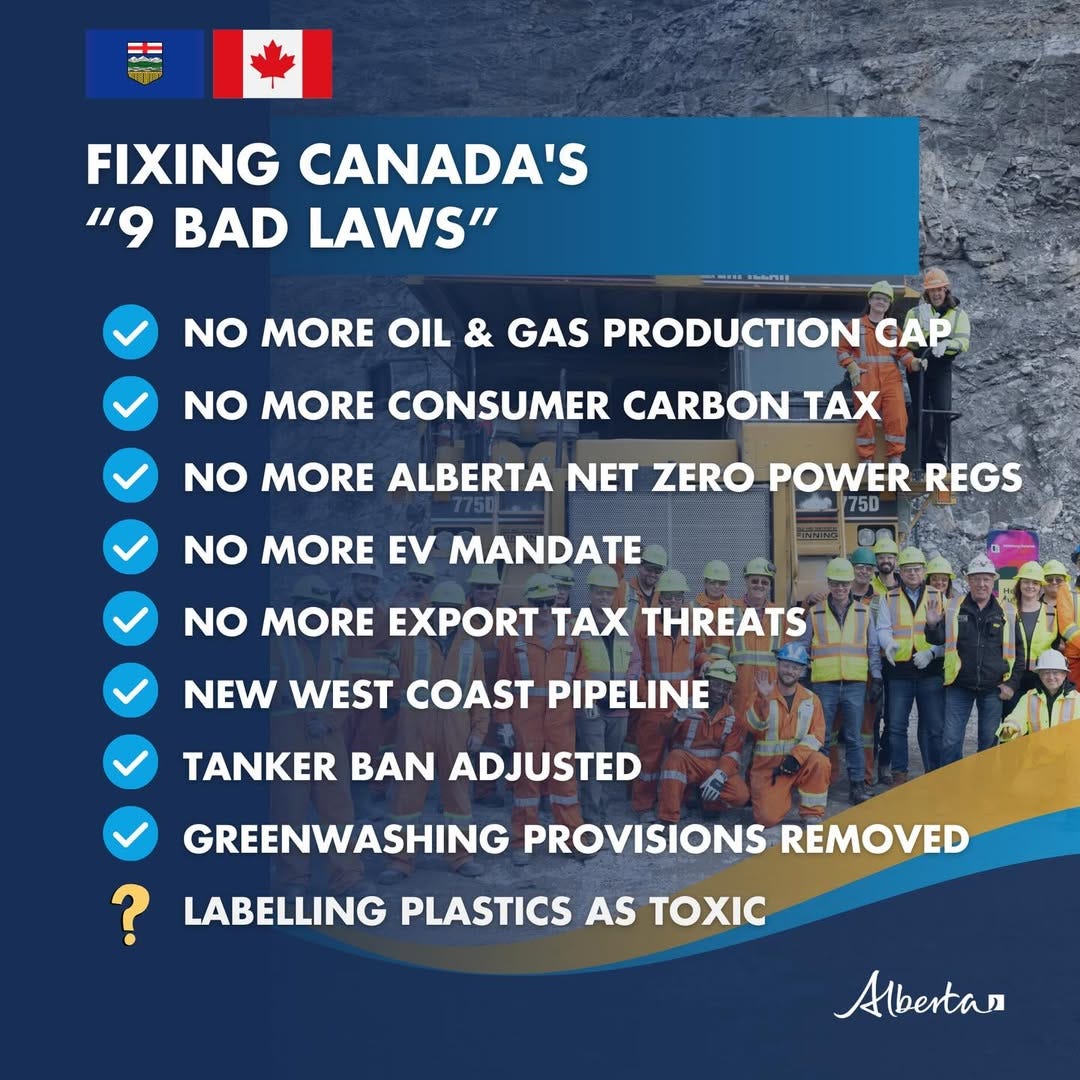
Source: Facebook
And so, when Carney greenlights the Smith’s latest pipeline fever dream while taking a hammer to some of the last remaining fragments of Canada’s climate policy, we should be aware of the overall context. This is not to excuse Carney, who has gone from an ascendant international climate leader to a running disaster on climate change.
Perhaps there’s a long game here that we’re not seeing. Perhaps the federal idea is to torpedo its climate legacy early in a sop to Alberta, and then turn the screws after the referendum vote. Perhaps it’s to make every appearance of bending over backwards even while the oil and gas industry works to undermine the pipeline deal from the other side. Or perhaps it’s to withdraw policy sticks at a time when the economic carrots of the clean energy transition have become impossible to ignore.
But Carney is, by all appearances, on the back foot. For a former Goldman Sachs executive, he seems surprisingly unwilling to play hard ball. Depending on your vantage point, he’s either getting played or making the necessary sacrifices for a united Canada. As someone who has watched Smith and the oil and gas industry for a long time, I’d urge Carney to stiffen his resolve. As a former goalie, he might appreciate the observation that Smith and the oil industry have a long history of moving goalposts. If they think they’ve got the Prime Minister over a barrel, there will be no end to their demands.